
The four classic links

Cuban Link
Oval links twisted so they lie flat and interlock tightly, like a heavy curb chain. Larger widths are often finished with a box clasp.
Bold and substantial; reads well on its own and at wider widths.
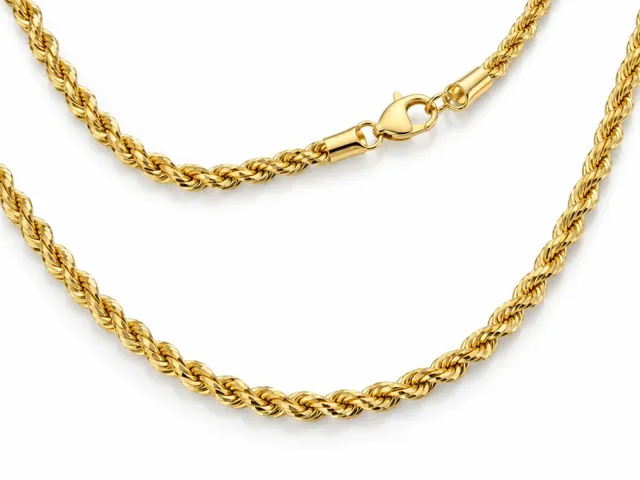
Rope
Small links woven in a spiral so the chain looks like twisted rope. The angled surfaces catch light from every direction.
Textured and lively; strong enough for a pendant at moderate widths.
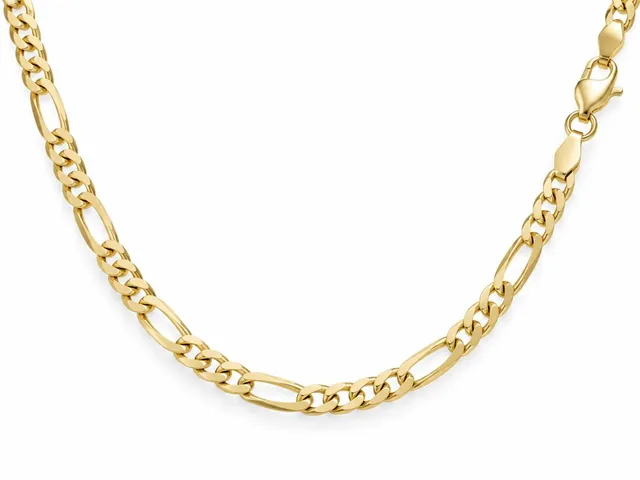
Figaro
A repeating pattern of short, flat links followed by one elongated link, often three short to one long.
Classic and recognizable; a little lighter in look than Cuban at the same width.
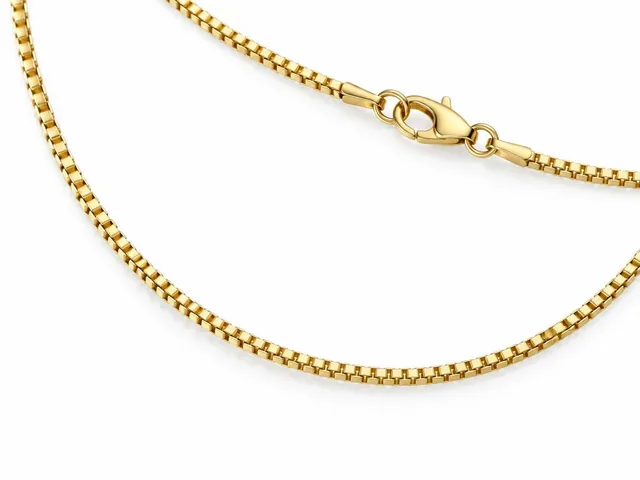
Box
Square links joined at right angles to form a smooth, boxy tube.
Clean and minimal; a common choice for carrying a pendant or medallion.
Photos aren’t to scale.
Solid vs. hollow
The same link style can be made solid, semi-solid or hollow. Hollow chains use less gold, so they feel lighter, but they dent and kink more easily and are harder to repair. The FTC Jewelry Guides say a gold item with a hollow center shouldn’t be described as “solid,” and the hollow construction should be disclosed next to the word “gold.”[1] Always ask how a chain is constructed.
For Terra’s review: Confirm whether Terra makes chains solid only, or also offers semi-solid or hollow options.
Widths, lengths and clasps
These are the options available today in the Custom Jewelry Studio, taken directly from the studio’s option list:
| Link | Widths | Lengths | Clasps |
|---|---|---|---|
| Cuban Link | 3 mm – 11 mm | 18 in – 30 in | Lobster clasp, Box clasp with safety |
| Rope | 1.5 mm – 5 mm | 16 in – 30 in | Spring ring clasp, Lobster clasp |
| Figaro | 2.5 mm – 7 mm | 16 in – 30 in | Lobster clasp |
| Box | 1 mm – 3.5 mm | 16 in – 30 in | Spring ring clasp, Lobster clasp |
- Lobster clasp: a spring-loaded hook; secure and easy to use one-handed.
- Box clasp with safety: a tongue that clicks into a box, plus a safety latch. It sits flush with wide links, which is why it’s offered on wider Cuban chains.
- Spring ring: a small round clasp suited to fine chains.
Where a chain sits
| Length | Typical placement on an average adult man |
|---|---|
| 18 in | Close to the base of the neck |
| 20 in | Around the collarbone; a popular everyday length |
| 22 in | Just below the collarbone |
| 24 in | Upper chest; common with a pendant |
| 26–30 in | Mid-chest; often worn over a shirt |
Neck size and build change where a chain falls, and wider chains sit slightly higher. The easiest check is to lay a string or an existing chain around your neck and measure it.
For Terra’s review: Confirm the typical placement descriptions match what Terra recommends to his customers.
Bracelet sizing
Measure your wrist just above the wrist bone with a soft tape or a strip of paper. Then add a little room: about ½ in for a snug fit, ¾ in for comfortable, or 1 in for loose. Wide, chunky links take up space inside the bracelet, so they need a little extra.
Enter your wrist size to see a suggested length.
A starting point only. Terra confirms the final length before anything is made. Lengths offered online: 6.5 in, 7 in, 7.5 in, 8 in, 8.5 in, 9 in.
For Terra’s review: Confirm the ½ / ¾ / 1 inch fit allowances and the extra allowance for wide links.
Care
- Take chains off to sleep, shower, swim or work out; that’s when links stretch and clasps get strained.
- Clean with warm water, mild soap and a soft brush, then dry thoroughly.[2]
- Hang chains or lay them flat so they don’t knot; untangle with a pin, never by pulling.
- Have clasps and jump rings checked once in a while, especially on chains you wear daily.
Put it into practice
Try your choices in Terra’s design tools, then send your saved design for a personal review. Nothing is ordered or priced online; Terra confirms every detail with you first.
Also helpful: 14K vs. 18K Gold vs. Platinum · Custom Jewelry
Sources
- 16 CFR § 23.3 — Misrepresentation as to gold content (hollow and “solid” gold) — FTC Jewelry Guides (eCFR)
- Tips on caring for jewelry — GIA